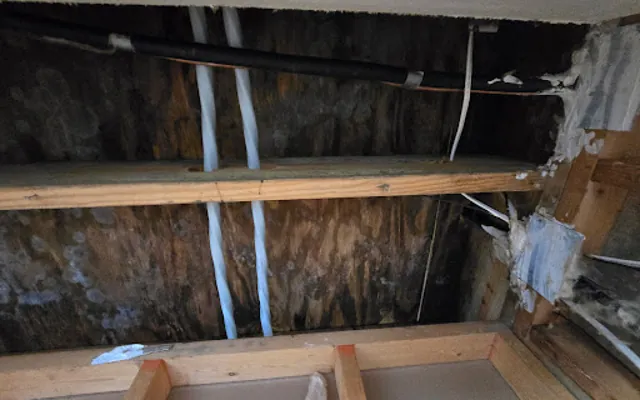
Ventura roofs never carry snowpack, so a classic ice dam does not form here, but on the coldest, clearest mornings a frost and debris backup at a hillside roofline can push water under the roofing anyway. The IICRC-standard crew responds in about an hour when it happens.

Crews check the affected valley or eave for debris buildup, frost residue, and the actual point where water pushed under the roofing material.
Standing water sitting in the attic or ceiling cavity directly below the affected roofline is extracted right away, before any structural drying can begin.
Air movers and dehumidifiers dry the attic insulation, decking, and ceiling drywall affected by the backup, with moisture checks continuing daily until everything reads dry.
Crews recommend clearing gutters and roof valleys of debris ahead of the next cold snap, since a clean roofline greatly reduces the chance of a repeat.

While help is on the way, these first steps, done only where it is safe, limit the damage and protect the insurance claim.
Shut the supply off at the source, or close the home's main valve if the source is not obvious. Stopping the flow limits the damage more than anything else.
Switch off electricity to the affected area, but only if the breaker can be reached without standing in or touching the water.
Get a crew dispatched right away. The sooner extraction and drying begin, the more flooring, drywall, and belongings can be saved.
Take photos and a short video of the water and the affected rooms before anything is moved, so the insurance claim starts strong.
Ice dam style roofline water damage cleanup in Ventura typically runs $500 to $2,500, since these events are usually limited to a single valley or section of eave rather than an entire roof. Gutter and valley clearing is inexpensive and often prevents a repeat. Homeowners insurance generally covers the resulting sudden water intrusion, and crews document the specific cold snap for your claim.
Crews reach Ventura and Ventura County fast, from Downtown Ventura and Midtown to Pierpont, the Ventura Keys, Ondulando, and nearby Oxnard and Ojai. See the full list on the areas served across Ventura page.
See all areas servedEvery loss is photographed, measured, and logged from the first visit, so the paperwork holds up with your insurance carrier.
Technicians follow recognized IICRC drying standards and prove the work with daily moisture readings, not guesswork.
Emergency dispatch any hour of the day or night, with a real crew on the way, not a callback in the morning.
A real crew dispatched any hour, not a callback in the morning.
Trained technicians following recognized IICRC drying standards.
Truck-mounted, portable, and submersible for any size loss.
The loss is documented and billed to the carrier directly.
Not in the classic melting snowpack sense, since Ventura roofs essentially never carry snow even in the hillside neighborhoods. What crews occasionally see is a much smaller scale frost and debris backup at a roof valley or eave on the coldest, clearest winter mornings, which produces similar symptoms without any real snow being involved.
Crews use the term because the symptoms, water backing up under roofing at a valley or eave and leaking into the attic, look the same to a homeowner, even though the actual mechanism here is frost and debris rather than melting snowpack. Crews are upfront about the difference during the inspection.
Keeping roof valleys and gutters clear of leaves and debris before winter is the single most effective step, since debris is almost always what allows a small frost layer to actually dam water rather than let it drain through normally.
Sudden water intrusion from a backed up roofline during a storm is generally covered the same as any other storm related roof leak. Crews document the specific cold snap and debris condition so the claim reflects what actually happened.
Ventura crews are on call 24 hours a day, local and fast, and can be on the way within the hour.
Call (805) 427-9593